
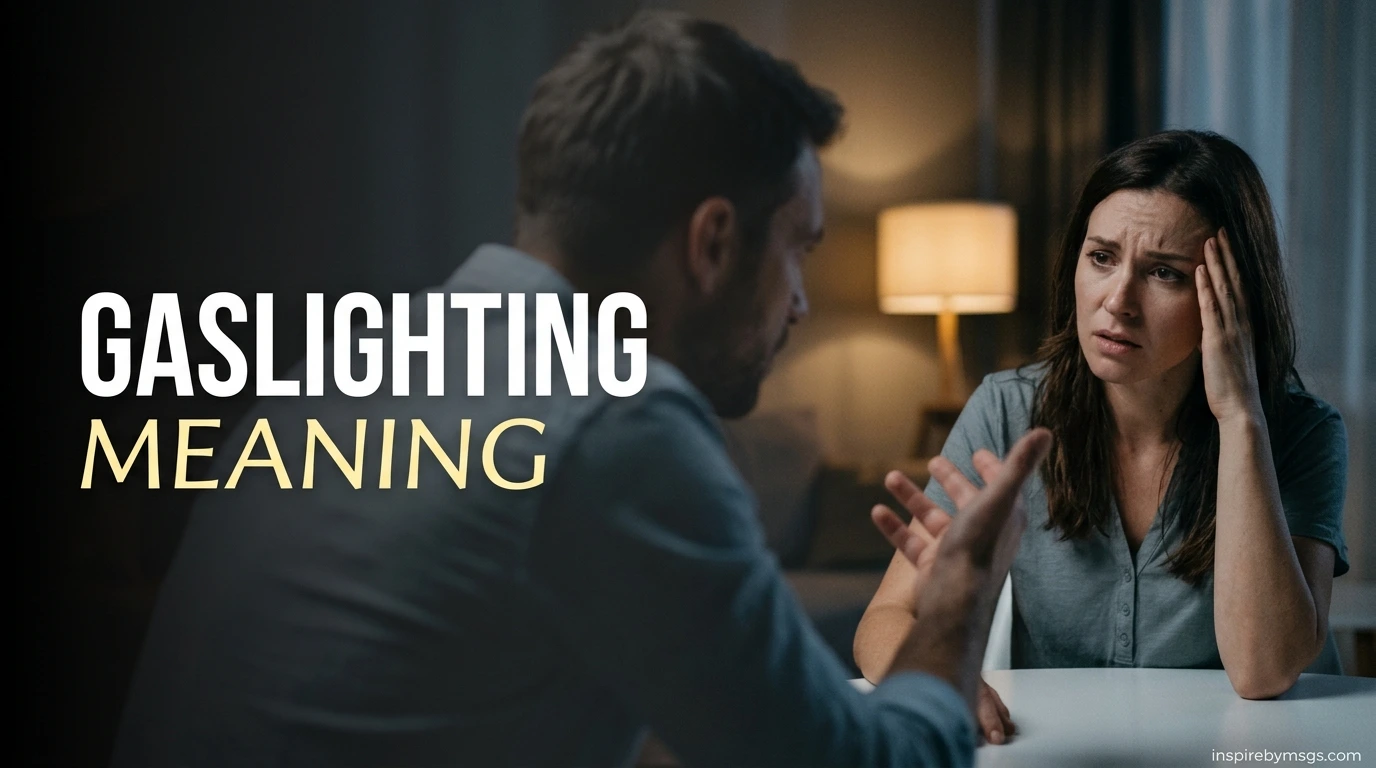
Imagine you tell a friend, “When we talked on Tuesday, you promised to help me move.” Your friend frowns and says, “Tuesday? We never talked on Tuesday. You must be remembering it wrong.” You feel confused. You clearly remember the conversation. But now you’re second-guessing yourself. Maybe you did mix up the days. Maybe you’re the one who’s confused.
That unsettling feeling — being made to doubt your own memory or perception — is exactly what the term gaslighting describes.
Gaslighting isn’t just lying. It’s a pattern of behavior where someone tries to make another person question what they know, saw, heard, or felt. The goal, whether conscious or not, is to gain control over how the other person sees reality. In this article, we’ll break down the gaslighting meaning in plain English, with realistic examples, so you can recognize it when you see it — and know what to do next.
Quick Answer: What Does Gaslighting Mean?
Gaslighting is a form of psychological manipulation in which one person tries to make another person doubt their own memory, perception, or sanity.
- Tone: Serious and negative. It describes harmful behavior, not a joke (though people sometimes use it loosely in casual conversation).
- Simple example: “I never said that. You’re imagining things again.” — said to someone who clearly heard the statement.
In short: gaslighting means making someone question what they know to be true. It’s about distorting reality until the other person stops trusting their own mind.
The Meaning of Gaslighting Explained Simply
At its core, gaslighting is about control through confusion. One person presents a version of reality that doesn’t match what actually happened, and they do it persistently enough that the other person starts to doubt themselves.
Here’s the key difference between gaslighting and an ordinary lie:
- A lie is a false statement. “I didn’t eat the last cookie.” Simple. Dishonest, but simple.
- Gaslighting goes further. It doesn’t just deny reality — it attacks the other person’s ability to perceive reality. “I never ate a cookie. You’re obsessed with my eating. Something’s wrong with you.”
In the second version, the focus shifts from the act to the person’s mind. That shift is the heart of the gaslighting meaning.
Gaslighting usually happens over time, not in a single moment. One confusing comment might just be a misunderstanding. A repeated pattern designed to undermine someone’s confidence is something else entirely.
What Gaslighting Is Not
It’s important to be precise, because the word gets used loosely online. Gaslighting is not:
- Simply disagreeing with someone
- Having a different memory of an event
- Giving honest feedback that stings
- Playing devil’s advocate in an argument
- A one-time lie or an accidental misstatement
The difference is intent and pattern. Gaslighting involves a sustained effort to make someone doubt themselves. Disagreement, by contrast, is two people honestly seeing things differently.
How Gaslighting Works: Purpose and Common Tactics
Gaslighting serves a purpose: it shifts blame and keeps the gaslighter in control. By making the other person feel confused or “crazy,” the gaslighter avoids accountability. If you doubt yourself, you stop challenging them.
Common tactics include:
- Denial: “That never happened.”
- Trivializing: “You’re overreacting. It was a joke.”
- Withholding: Refusing to engage. “I’m not doing this again. You always start fights.”
- Countering: “No, you’re the one who’s being manipulative.”
- Blocking: Changing the subject so the original issue never gets resolved.
- Forgetting: Claiming not to remember something important, then blaming the other person for “bringing it up again.”
None of these tactics is gaslighting on its own. The pattern is what matters. When someone consistently uses these moves to make you question your own mind, that’s the gaslighting meaning in action.
Literal vs. Figurative Meaning: Why the Word Is Named After a Gas Lamp
The term gaslighting comes from the 1938 play Gas Light by British playwright Patrick Hamilton, later adapted into the 1944 film Gaslight starring Ingrid Bergman and Charles Boyer.
In the story, a husband tries to convince his wife she’s losing her mind. One of his tricks involves dimming the gas lamps in their home and then denying the lights changed when she notices. The flickering light becomes proof, to her, that she can’t trust her own eyes. The audience, of course, sees the truth.
That’s where the word comes from. The literal meaning points to a physical gas lamp. The figurative, modern meaning points to psychological manipulation — making someone doubt the light they can clearly see.
The word later moved into psychology and counseling language in the 20th century. Today, it’s one of the most searched emotional-health terms on the internet, and it shows up in articles, social media posts, and everyday conversation.
How the Meaning Changes with Context
The gaslighting meaning can shift depending on who’s speaking and where.
- In mental health writing and counseling: The term is used carefully and precisely. It describes an abusive pattern, often within relationships, families, or workplaces.
- In social media and casual conversation: The word is used more loosely. Sometimes people say “That’s gaslighting!” when they simply mean “You’re denying what you did” or “You’re twisting my words.” This looser usage isn’t always accurate, but it’s common.
- In text messages: The meaning is usually the same, but tone is harder to read. A short message like “you’re remembering it wrong again” can feel neutral in one conversation and manipulative in another — it depends on history and repetition.
- In gaming or online communities: People sometimes joke “stop gaslighting me” about in-game events or memes. This is playful exaggeration, not literal manipulation.
So when you see the word, ask: Is the speaker describing a serious pattern, or using the term casually? The definition stays the same, but the weight of the accusation changes with context.
Gaslighting in Texting and Social Media
Texting adds a layer of ambiguity to gaslighting. Without tone of voice or facial expressions, it’s easier to “misremember” — or to claim you misremembered.
Common texting patterns that can look like gaslighting include:
- “I never texted that. Screenshot or it didn’t happen.”
- “You’re reading too much into it. I was joking.”
- “Why are you always like this? You’re exhausting.”
- Deleting messages, then denying they existed.
- Responding to a clear request with “I don’t know what you’re talking about.”
These lines aren’t automatic proof of gaslighting. But when they repeat and consistently make you doubt yourself, they fit the definition.
One important note: screenshots and saved messages matter. One of the most practical ways to counter gaslighting is to keep records. If your memory keeps getting challenged, written evidence protects you — not because you need to “win” arguments, but because it helps you stay grounded in reality.
The Difference Between Lying, Denying, and Gaslighting
These three words get mixed up constantly. Here’s a simple comparison:
| Term | Meaning | Example | Tone |
| Lying | Saying something false on purpose | “I didn’t take your charger.” (They did.) | Dishonest but direct |
| Denying | Refusing to admit something | “I didn’t do that.” | Defensive, one-off |
| Gaslighting | Making someone question their own mind | “You’re imagining things. I’m worried about you.” | Manipulative, repeated |
| Manipulation | A broad category of controlling behavior | Guilt-tripping, love-bombing | Negative, often strategic |
| Invalidation | Dismissing someone’s feelings | “You’re overreacting.” | Insensitive, not always abusive |
A lie is a false statement. Gaslighting is a campaign against someone’s trust in themselves. That distinction is the most important thing to remember about the gaslighting meaning.
Realistic Examples Grouped by Situation
Here are examples of how gaslighting shows up in everyday life. Each one includes a short dialogue and a note on what’s happening.
Relationships and Dating
Example 1
A: “You said you’d call me last night.”
B: “I never said that. You always twist things.”
What’s happening: Denial plus blame-shifting. If this happens once, it could be a misunderstanding. Repeated, it’s a pattern.
Example 2
A: “I felt hurt when you made that joke about me in front of your friends.”
B: “You’re too sensitive. I can’t say anything around you.”
What’s happening: The joke is ignored, and the focus moves to A’s “sensitivity.” This is trivializing and blame-shifting.
Family Conversations
Example 3
Parent: “I never said you had to choose that career. You’re making things up.”
Child: “You told me for years that I’d be wasting my life otherwise.”
What’s happening: A common family pattern where the past is rewritten. The child may start to doubt their own memory.
Example 4
A: “Can we talk about what happened at dinner?”
B: “What happened at dinner? Nothing happened. You’re being dramatic.”
What’s happening: “Nothing happened” wipes out the event entirely. This is a classic gaslighting move.
Workplace
Example 5
Manager: “I never told you the deadline was Friday.”
Employee: “It’s in the email you sent.”
What’s happening: The employee has evidence, which changes the dynamic. Without evidence, this kind of denial can make workers doubt themselves.
Example 6
Colleague: “You’re remembering the meeting wrong. Everyone agreed with my plan.”
What’s happening: Speaking for “everyone” is a common way to make one person feel isolated and confused.
Texting and Social Media
Example 7
Text A: “you said you’d be here at 7”
Text B: “i never said that lol you’re so dramatic”
What’s happening: “lol” softens the denial but doesn’t change it. Adding “you’re dramatic” flips the blame.
Example 8
Text A: “you deleted the messages you sent me”
Text B: “no i didn’t. you’re imagining things again”
What’s happening: “Again” frames the other person as unreliable. That word is doing the gaslighting work.
Casual and Online Use
Example 9
“Stop gaslighting me about the score — I saw it with my own eyes.”
What’s happening: This is playful or semi-serious. It borrows the term for a minor dispute, not real abuse.
Example 10
“People keep gaslighting me into thinking Mondays are fine.”
What’s happening: A joke. The word is used loosely on social media; no actual manipulation is implied.
Example 11
Friend A: “You promised you’d come.”
Friend B: “I said maybe. You always hear what you want to hear.”
What’s happening: “Maybe” may be true, but the second sentence attacks A’s hearing and motives. That’s the manipulative part.
When It’s Probably Not Gaslighting
Example 12
A: “You said the party was at 8.”
B: “I thought it was 7. My bad — I must have mixed it up.”
What’s happening: A genuine mistake with accountability. Not gaslighting. The apology is the tell.
How to Reply to Gaslighting
There’s no perfect script, because gaslighting happens in real relationships with complex dynamics. But a few replies can help you stay grounded:
- Stick to facts. “I remember it differently, and I’m not going to argue about my memory.” Keep it short. Don’t take the bait.
- Name the pattern calmly. “When you tell me I’m imagining things, it makes it hard to talk. I’d rather focus on what happened.”
- Avoid endless debating. If someone is committed to denying reality, more arguing won’t help. State your position once and let it stand.
- Keep a record. Notes, screenshots, or a journal help you stay clear on what actually happened.
- Seek outside perspective. A trusted friend or counselor can help you check your reality when you’re unsure.
- Set boundaries. “I’m not going to keep discussing this if you tell me I’m crazy.” Then follow through.
In serious or repeated cases, consider talking to a counselor or a trusted support person. Gaslighting can be a component of emotional abuse, and professional help can make a real difference. If you ever feel unsafe, prioritize your safety and reach out to local support services.
Related Terms Worth Knowing
Gaslighting is related to several other words you may see online:
| Term | Meaning | How it relates to gaslighting |
| Manipulation | Controlling someone’s behavior or feelings | Gaslighting is a specific type of manipulation |
| Invalidation | Dismissing someone’s feelings as wrong | Often used alongside gaslighting |
| Dismissiveness | Treating someone’s concerns as unimportant | A softer cousin; not always abusive |
| Blaming / Blame-shifting | Making someone else responsible for your actions | Common gaslighting tactic |
| DARVO | Deny, Attack, Reverse Victim and Offender | A pattern often compared to gaslighting |
| Love-bombing | Overwhelming someone with affection to gain control | Sometimes appears in the same relationships |
DARVO is worth remembering. It stands for Deny, Attack, Reverse Victim and Offender — a sequence where someone denies wrongdoing, attacks the person confronting them, and then claims to be the real victim. It overlaps heavily with gaslighting behavior.
Is “Gaslighting” Formal, Informal, or Offensive?
- Formal writing and counseling: Gaslighting is a precise, serious term. Use it carefully and don’t overstate.
- Casual conversation: It’s common and widely understood, but it’s often used loosely.
- As an accusation: Calling someone a gaslighter is a serious claim. It can feel hostile or hurtful, especially if used carelessly.
- Playfully: Friends sometimes joke about “gaslighting” in games or minor disputes. This is generally harmless among people who know each other, but it can confuse the meaning for beginners.
The word is not inherently rude, but how you use it matters. Accusing someone of gaslighting when they simply disagree with you waters down the term and can hurt the other person unfairly.
When to Use the Term — and When to Avoid It
Appropriate situations:
- Describing a repeated pattern of denial and self-doubt in a relationship
- Discussing emotional abuse with a counselor or trusted person
- Explaining the concept in educational content (like this article)
- Calling out a clear, documented pattern in a workplace or family setting
Situations to avoid:
- A single disagreement or different memory
- When you’re angry and want a strong word to “win” an argument
- When you don’t have a clear pattern to point to
- As a joke with someone who might not understand the term
Common Misunderstandings About Gaslighting
- “Gaslighting is just lying.” No — it’s a pattern aimed at making someone doubt themselves.
- “It only happens in romantic relationships.” It can happen in families, workplaces, friendships, and online.
- “It’s always intentional.” Intent is debated. Some people repeat manipulative patterns they learned without fully realizing it. The impact on the other person still matters.
- “If I feel confused, I’m being gaslit.” Confusion can come from many sources. Look for a repeated pattern, not a single moment.
- “Gaslighting is always dramatic.” It’s often subtle — small denials, tiny rewrites of history, repeated over time.
- “Only women experience it.” Anyone can experience gaslighting, and anyone can do it. The behavior matters, not gender.
- “Saying ‘you’re gaslighting me’ ends the conversation.” It’s a serious claim. It should invite reflection, not shut things down.
A Brief Illustrative Scenario
This is a made-up example to show how ambiguity works, not a documented case.
Sam and Riley plan a trip. Sam remembers agreeing to split costs. Riley remembers Sam offering to pay. Neither has a written record. When Sam brings it up, Riley says, “You always do this — you make things up to get your way.”
Sam now has two problems: the money, and the accusation that Sam is fabricating memories. One comment alone proves nothing. But if Riley says this every time money comes up, and Sam starts avoiding the topic out of self-doubt, that’s the kind of pattern the word gaslighting describes.
The lesson: look for patterns, keep records, and trust that your memory deserves respect.
Frequently Asked Questions
What is the simple meaning of gaslighting?
Gaslighting means making someone doubt their own memory, perception, or sanity. It’s a form of psychological manipulation, usually repeated over time.
Where does the word gaslighting come from?
It comes from the 1938 play Gas Light and the 1944 film Gaslight, in which a husband dims the gas lamps and denies it to make his wife think she’s losing her mind.
Is gaslighting the same as lying?
No. Lying is a false statement. Gaslighting is a pattern of manipulation designed to make someone question their own mind.
How do I know if I’m being gaslit?
Look for a repeated pattern: constant denial of things you clearly remember, being told you’re “too sensitive,” feeling confused and apologizing often, and doubting your own memory. Keep notes and talk to someone you trust.
Can gaslighting happen in text messages?
Yes. Denying messages, deleting them, or saying “you’re imagining things” in texts can be gaslighting, especially when it’s repeated.
Is gaslighting always intentional?
Not necessarily. Some people repeat manipulative habits without fully realizing it. What matters most is the impact and the pattern.
What’s the difference between gaslighting and disagreeing?
Disagreement is honest and mutual. Gaslighting is one-sided and aims to make you doubt your own reality.
What should I do if someone gaslights me?
Stay calm, state facts briefly, keep records, set boundaries, and seek support from a trusted friend or counselor. If you feel unsafe, prioritize your safety.
Conclusion
The gaslighting meaning comes down to one clear idea: making someone doubt their own mind. It’s not a single lie or a simple disagreement — it’s a repeated pattern of denial, blame-shifting, and reality-twisting that leaves the other person confused and insecure. The word comes from a 1938 play, but the behavior is as old as manipulation itself. In texting, social media, relationships, and workplaces, the definition stays the same, even when the tone shifts from serious to playful. Use the term carefully and honestly, look for patterns rather than one-off moments, and remember: your memory and your perceptions deserve to be respected.
