
You’re reading a news article about a country where a handful of wealthy families seem to control everything. A sentence says the nation has become an “oligarchy.” You understand the gist, but you’re not totally sure what the word means or whether it’s being used literally or as an insult.
Or maybe you saw the word in a social media post about billionaires, politicians, and who really holds power. Someone in the comments calls it an “oligarchy,” and you want to know if that’s an accurate use of the term or just dramatic wording.
Oligarchy is one of those political words that sounds complicated but has a fairly straightforward core meaning. Once you understand it, you’ll start noticing it everywhere — in news coverage, history class, and everyday debates about power and money. This guide breaks down the oligarchy meaning in plain English, with examples, comparisons, and common misunderstandings.
Quick Answer: What Does Oligarchy Mean?
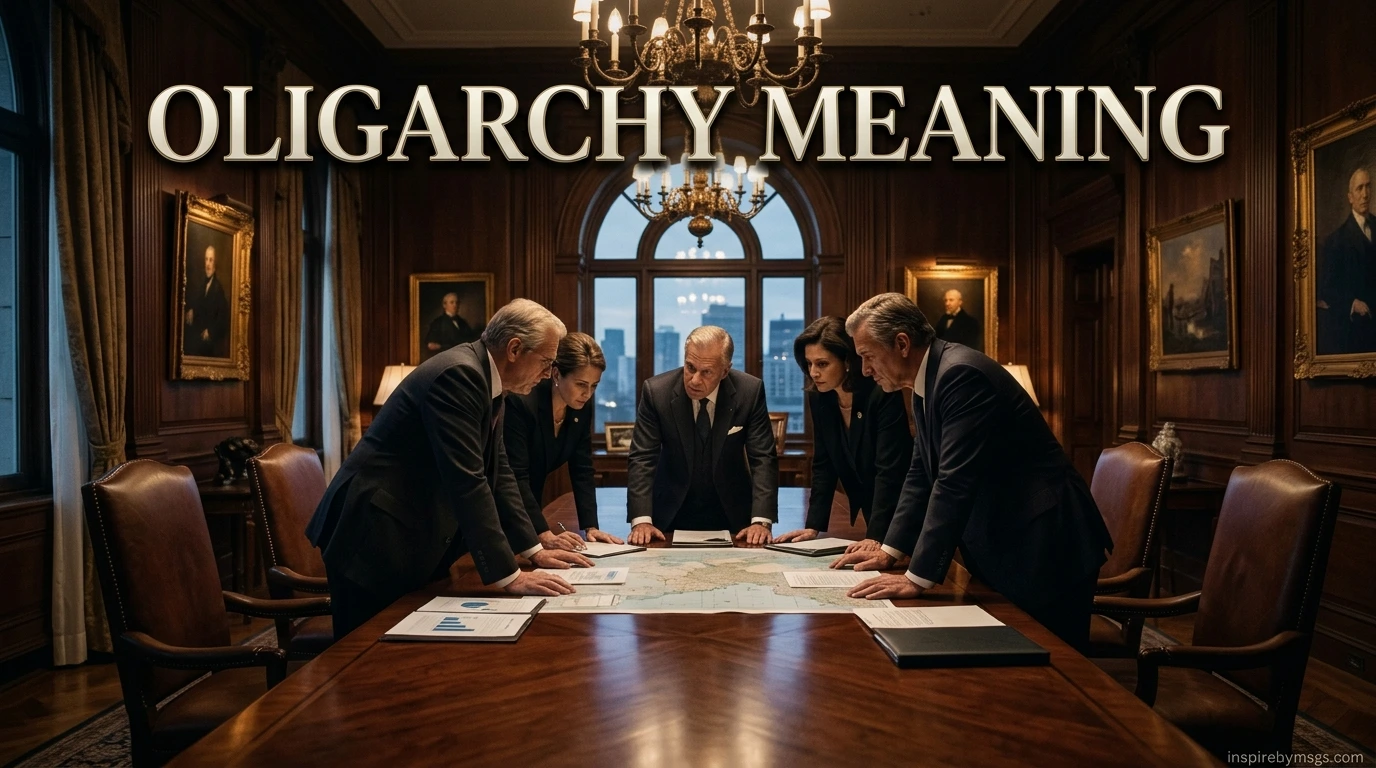
Oligarchy (pronounced “AH-lih-gar-kee”) is a form of government or power structure in which a small group of people controls most of the decisions. The word comes from Greek: oligos (“few”) and arkhein (“to rule”) — literally, “rule by the few.”
- Tone: Neutral and descriptive in academic, journalistic, and historical writing. It can be critical or accusatory when applied to a current government or institution.
- Simple example: “The country was ruled by an oligarchy of wealthy landowners who controlled the parliament.”
The key idea is concentration of power in a few hands — not necessarily a single dictator, and not necessarily a majority vote. A small, connected group holds disproportionate control.
Oligarchy Meaning: The Full Explanation
At its core, an oligarchy is about who holds power and how many people share it. In a democracy, power is theoretically spread across the population through elections. In an oligarchy, power is concentrated in a small, often self-selecting group.
That group might be defined by:
- Wealth — wealthy business owners, industrialists, or families
- Family ties — dynasties that pass power down generations
- Military control — generals or armed factions
- Political party membership — a small elite within a ruling party
- Religion — a clerical class holding authority
- Land ownership — large landowners controlling rural populations
Importantly, an oligarchy isn’t always an official system written into a constitution. It can be a formal system or an informal reality. A country might hold elections and still function as an oligarchy if a small elite consistently controls the levers of power, the media, and the economy.
What Oligarchy Is Not
The word is often misused, so it helps to rule out a few things:
- It is not the same as a monarchy. A monarchy centers on one ruler (a king, queen, or emperor). An oligarchy centers on a small group.
- It is not the same as a dictatorship. A dictatorship can be run by one person. An oligarchy involves multiple people sharing power, even if that group is small.
- It is not a synonym for “rich people.” Wealthy people can exist in any system. An oligarchy specifically refers to a small group holding political or institutional power, often through wealth.
Why the Term Matters
The oligarchy meaning matters because it describes a real pattern of power that appears throughout history and in modern debates. When people use the word, they’re usually making a claim about who actually controls decisions — not just who votes or who holds a title.
That makes the term useful, but also contentious. Calling a government an oligarchy is a serious claim. It implies that formal democratic processes are being undermined by a narrow elite. That’s why the word often appears in political criticism, not just neutral description.
Literal vs. Figurative Meaning
Like many political words, “oligarchy” has a literal meaning and a looser, figurative one.
Literal meaning: A system of government in which a small group actually rules — for example, a council of wealthy families holding formal authority.
Figurative meaning: A situation where a small group dominates a particular sphere, even if it isn’t a government. People say things like “the tech industry is an oligarchy” to mean a few powerful companies or executives control the market and the conversation.
The figurative use is common in casual writing and social media. It’s not wrong, but it’s looser. When you see the word, ask yourself: Is this describing an actual political system, or is it describing concentrated power in a company, industry, or institution? That distinction changes how seriously the claim should be taken.
How Oligarchy Is Used in a Sentence
Understanding the oligarchy meaning is easier when you see how the word behaves grammatically.
- As a noun: “The oligarchy blocked the reform bill.”
- As a countable noun: “Different oligarchies have risen and fallen across history.”
- As an adjective form: “Oligarchic” — “The country’s oligarchic structure resisted change.”
- For a member: “Oligarch” — “The oligarchs controlled the country’s largest industries.”
A quick grammar note: “oligarch” refers to a person who is part of an oligarchy. “Oligarchic” describes the system. “Oligarchy” is the system itself.
Realistic Examples by Situation
Here are examples grouped by context, with a brief interpretation of each.
News and Political Coverage
- “Critics say the country has drifted toward oligarchy as a handful of business families gained control of key industries.”
→ The word is used critically to describe informal concentration of power, not a formal title. - “The revolution overthrew the old oligarchy and promised free elections.”
→ Here, “oligarchy” refers to a recognized ruling elite that held power before the change. - “Analysts debate whether the nation is a democracy with oligarchic features.”
→ This is a careful, qualified use — power is concentrated but not absolute.
History Class
- “In some ancient Greek city-states, oligarchy meant rule by a small council of wealthy citizens.”
→ A literal, historical use of the term. - “The empire’s oligarchy of generals and landowners resisted reforms for decades.”
→ The group is defined by military and land-based power.
Business and Industry
- “Some commentators call the airline industry an oligarchy because a few companies dominate the market.”
→ A figurative use: concentrated economic power rather than a government system. - “The board functioned like an oligarchy, with three executives making every major decision.”
→ Informal use inside an organization.
Social Media and Everyday Debate
- “People keep saying billionaires run everything — is that an oligarchy?”
→ A genuine question about the term’s meaning, often answered with nuance. - “Calling every problem an oligarchy waters down the word.”
→ A reminder that the term should be used precisely. - “The housing crisis isn’t just a market issue; some argue it reflects an oligarchy of developers and policymakers.”
→ A figurative, critical use combining economic and political power.
Hypothetical Scenario: One Word, Two Readings
Imagine two people read the same headline: “A small group of families controls the country’s largest companies and most of its media.”
- Reader A says: “That’s an oligarchy.” They mean the country has an informal power structure where a few families dominate both business and public information.
- Reader B says: “That’s not an oligarchy unless those families actually hold government power.”
Both readings are reasonable. Reader A is using the looser, figurative sense; Reader B is insisting on the strict political definition. This is exactly why context matters — the same word can describe a formal system or a pattern of concentrated influence. This scenario is illustrative, not a documented case.
How to Understand and Use Oligarchy Naturally
You don’t need to “reply” to the word oligarchy the way you’d reply to a text abbreviation. Instead, the skill is knowing when to use it and when to avoid it.
- Use it precisely when a small group holds real political or institutional power. “The council was an oligarchy” is clear; “my group chat is an oligarchy” is playful exaggeration.
- Qualify it when you’re describing a trend rather than a fact. “Critics describe it as an oligarchy” is safer than “it is an oligarchy.”
- Don’t use it as a generic insult. Calling every frustrating system an oligarchy weakens the term.
- Watch the surrounding words. “Oligarchy” often appears alongside words like elite, wealth, control, families, corporations, and power — these signal whether the writer means a literal system or a figurative concentration of influence.
Oligarchy vs. Related Terms
The oligarchy meaning becomes clearer when you compare it with similar words.
| Term | Core Meaning | Key Difference from Oligarchy |
| Oligarchy | Rule by a small group | The broadest term for small-group power |
| Aristocracy | Rule by a privileged upper class, often hereditary | Aristocracy implies social rank or nobility; oligarchy emphasizes fewness of rulers, not their pedigree |
| Monarchy | Rule by one person (king, queen, emperor) | Monarchy = one ruler; oligarchy = a small group |
| Plutocracy | Rule by the wealthy | Plutocracy is a type of oligarchy defined specifically by wealth |
| Autocracy | Rule by one person with unlimited power | Autocracy = one absolute ruler; oligarchy = a small ruling group |
| Democracy | Rule by the people, usually through elections | Democracy spreads power broadly; oligarchy concentrates it |
A useful way to remember the difference: plutocracy is an oligarchy of the rich; aristocracy is an oligarchy of the “best-born”; monarchy is rule by one.
Tone and Formality: Is Oligarchy a Rude Word?
Oligarchy is formal and academic in register, but it carries a critical edge when applied to current events.
- In a history textbook or encyclopedia: neutral and descriptive.
- In a news analysis piece: often skeptical or critical.
- In a social media post: frequently accusatory or rhetorical.
- In casual conversation: can be playful exaggeration (“our family is an oligarchy when it comes to choosing dinner”).
It is not a slur or an offensive term, but it is a serious political accusation. Calling a government an oligarchy implies that democratic processes are being undermined. Use it with care in professional writing, and back up the claim with specifics rather than just dropping the word.
Common Misunderstandings
- “Oligarchy means one person rules.” No — that’s autocracy or dictatorship. Oligarchy means a small group.
- “Oligarchy is always about money.” Wealth is a common basis, but power can also come from military control, family lineage, religion, or party membership.
- “If a country has elections, it can’t be an oligarchy.” Elections and oligarchy can coexist. A small elite can dominate politics even with formal voting in place.
- “Oligarchy is just a fancy word for inequality.” Inequality is an economic measure. Oligarchy is about political power. The two often overlap, but they aren’t the same thing.
- “Oligarchs are always officially in charge.” Often the most powerful figures in an oligarchy operate behind the scenes rather than holding formal titles.
A Brief Note on Origin and History
The word oligarchy comes from ancient Greek and was used to describe one of several forms of government discussed by Greek thinkers. It was contrasted with democracy (rule by the people) and monarchy (rule by one). The term has been used in political writing ever since to describe small-group rule. Because the word’s origins are well documented in classical political thought, its basic meaning has remained remarkably stable: rule by the few.
Frequently Asked Questions
What is the simple definition of oligarchy?
Oligarchy is a system in which a small group of people holds most of the power and makes the key decisions, often because of wealth, family ties, military control, or political connections.
What does oligarch mean?
An oligarch is a person who belongs to the small group that holds power in an oligarchy — for example, a wealthy business figure with strong political influence.
Is the United States an oligarchy?
This is a debated question, not a settled fact. Some scholars and commentators argue that concentrated wealth and influence give a small elite disproportionate power; others argue that democratic institutions and elections prevent true oligarchy. The word is best used carefully and with evidence.
What is the difference between an oligarchy and a plutocracy?
A plutocracy is specifically rule by the wealthy. It is a type of oligarchy in which wealth is the defining basis of power.
Can an oligarchy be a democracy?
In practice, a country can hold elections while a small elite dominates key institutions and decisions. In that case, commentators might describe it as having oligarchic features rather than being a pure oligarchy.
Is oligarchy a negative word?
It is neutral in academic use but often critical in political commentary, since it implies that power is concentrated in a few hands rather than shared broadly.
How do you pronounce oligarchy?
It’s pronounced “AH-lih-gar-kee,” with the stress on the first syllable.
Conclusion
The oligarchy meaning comes down to one clear idea: rule by a few. It describes a system, or a pattern, in which a small group — often defined by wealth, family, military power, or political ties — holds most of the control. The word is neutral in a textbook but carries a critical edge in news and social media, where it’s used to question who really holds power. Remember the key distinctions: an oligarchy is not a monarchy (one ruler) and not a dictatorship (one absolute ruler), and it isn’t simply a synonym for inequality. When you see the word, check the context — literal political system or figurative concentration of influence — and you’ll understand the claim being made.
